SDSU Speaks
How students at San Diego State University use their voices to enact change
By: Catherine Curley
Published: Dec. 6, 2025
SDSU speaks audio story:
Story Highlights
* SDSU Graduate Student Zareeb L. shares his experience at the No Kings protest and his perspective on the Trump administration and free speech.
* The Israel-Palestine conflict has manifested on campus with students speaking out in support of both sides.
* Gen Z College students are statistically one of the most politically active demographics in America but more than half of their activism is invisible, according to a Gen Z survey conducted by United Way of the National Capital Area.
SAN DIEGO -The First Amendment has been the center of debate the past several years. Filters and limitations applied under the Trump administration, such as mediation of political statements on broadcast television and other forms of mass media, control over the press’ access to government information, and constraints on what is allowed to be included in public education have ignited a nationwide defense for free speech.
Students at San Diego State University (SDSU) have always used their campus as a platform to protect and exercise their speech. From protests against the Vietnam War to confronting the university president, they make their voice known.
On June 14, 2025 the “No Kings” movement mobilized nationally to protest President Donald Trump and his perceived ascent into an authoritarian dictator. That day, Trump’s birthday, the celebratory parades were drowned out by millions of Americans expressing their dissatisfaction with the administration. Since then, the movement has been reignited by escalating anti-immigrant policy from the Trump administration.
On Oct. 18, over seven million people gathered across the nation to protest, “President Trump’s attempt at a coronation,” citing “sending militarized agents into (American) communities, silencing voters, and handing billionaires giveaways while families struggle,” as the most recent of his unconstitutional abuses of power, according to the official statement from No Kings website.
From 11 a.m. to 1 p.m. on that Saturday, SDSU community members organized at the intersection of Montezuma Road and College Avenue for the No Kings: San Diego, College Area event.
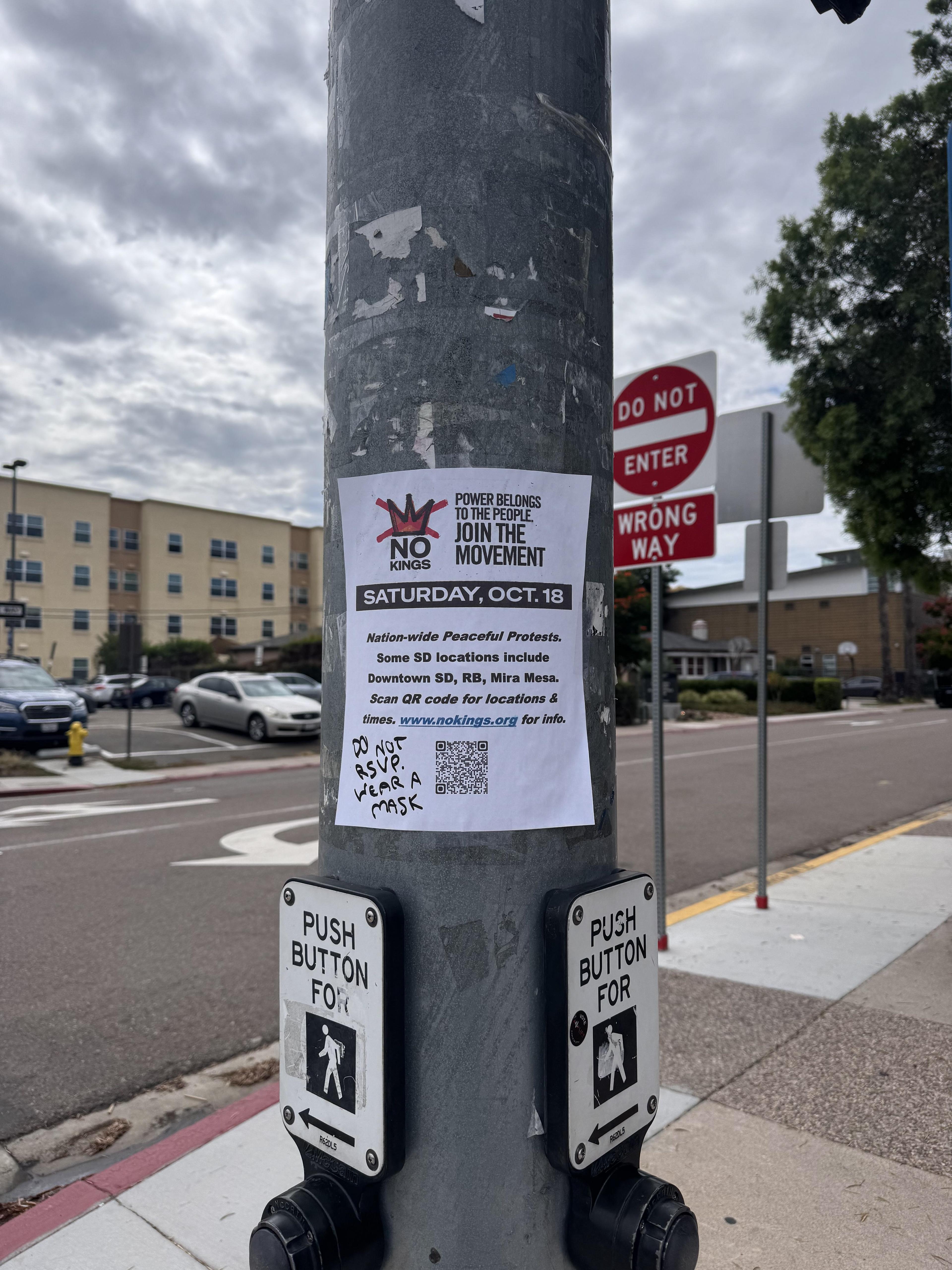
A flyer on the corner of Campanile Drive and Hardy Ave. on SDSU campus announcing the No Kings Protests. Photo credit: Catherine Curley
According to a report by Leila Stojanovic from The Daily Aztec, San Diego State’s student newspaper, the event was organized by an SDSU staff member who wanted to make a local rally for students without transportation. Hundreds of people showed up to join this peaceful protest. Many other colleges hosted a No Kings event that day, including Penn State, Columbia University and UC Berkeley.
San Diego State graduate student, Zareeb L., says, “I've been an activist my whole life.”
Zareeb was hesitant to share his identity given the government’s relationship with international and ethnic students.
Zareeb attended the No Kings rally in Long Beach, California on Oct. 18. He has lengthy experience in advocacy, including attending protests that experienced police brutality during his time as a student in the Philippines. Given this experience, he had expected more from American democracy.
“I was told we had a First Amendment, but yeah, that only exists for the few; the elites,” Zareeb said.
“If you're an international student and you're out here on a Visa, the State Department explicitly said that we (America) won't welcome you if you're expressing views that are contrary to American principles, and that includes apparently criticizing the government or supporting Palestine,” he said.
Students for justice in Gaza
Much like it is globally, the war in Gaza is a point of contention on SDSU’s campus. The humanitarian crisis has been one of most controversial topics on campus in the modern age, but the October 7th attack in 2023 was a tipping point for many. A walk was held on campus on Oct. 9, in solidarity with Israel, later followed by an on-campus march from the student organization Students for Justice in Palestine (SJP) on Oct. 11.
SDSU student Jasmin Zeis-Khalil created a pop-up cafe this past October at her house to fundraise for SJP. Another student, Charlotte Hopkins, hosted an art market for SJP last semester.
“It was kind of like a clothing drive where people donated clothes, we had baked goods, and then the money that we made went to Heal Palestine, which is an organization that supports individuals and families in Palestine,” Hopkins said. “I’ve become a lot more passionate about politics and these kinds of things (since) being in college and being surrounded by likeminded people,” she said.
The SDSU student body has continued to organize events on and off campus to speak out. There have been protests, fundraising events and vigils for those who have been lost in the war. The Israel-Palestine conflict and immigrant rights are some of the most important issues for student activists.
SDSU student activism timeline
SDSU’s proximity to the U.S.-Mexico border has ignited a strong defense on campus against the recent ICE crack downs and the threat it poses to many students. On Sept. 11, 2025, Movimiento Estudiantil Chicanx de Aztlán (M.E.Ch.A) held a protest on campus calling out SDSU administration’s silence on the subject and as a response to the Supreme Court’s approval of immigration raids and racial profiling. Several months before that, on Feb. 22, there was a similar student protest on campus meant to show support for undocumented students.
College-aged people have been known to express more political unrest. A look through SDSU’s virtual “Protest Tour”, supported by philanthropy program, Aztec Proud, shows students' lasting commitment to righteousness and making change, dating back to the 1960s.
According to a 2016 study by UCLA’s Higher Education Research Institute “nearly 1 in 10 incoming first-year students expects to participate in student protests while in college.” They also found that college students’ political and civic engagement had been climbing over the past 50 years.
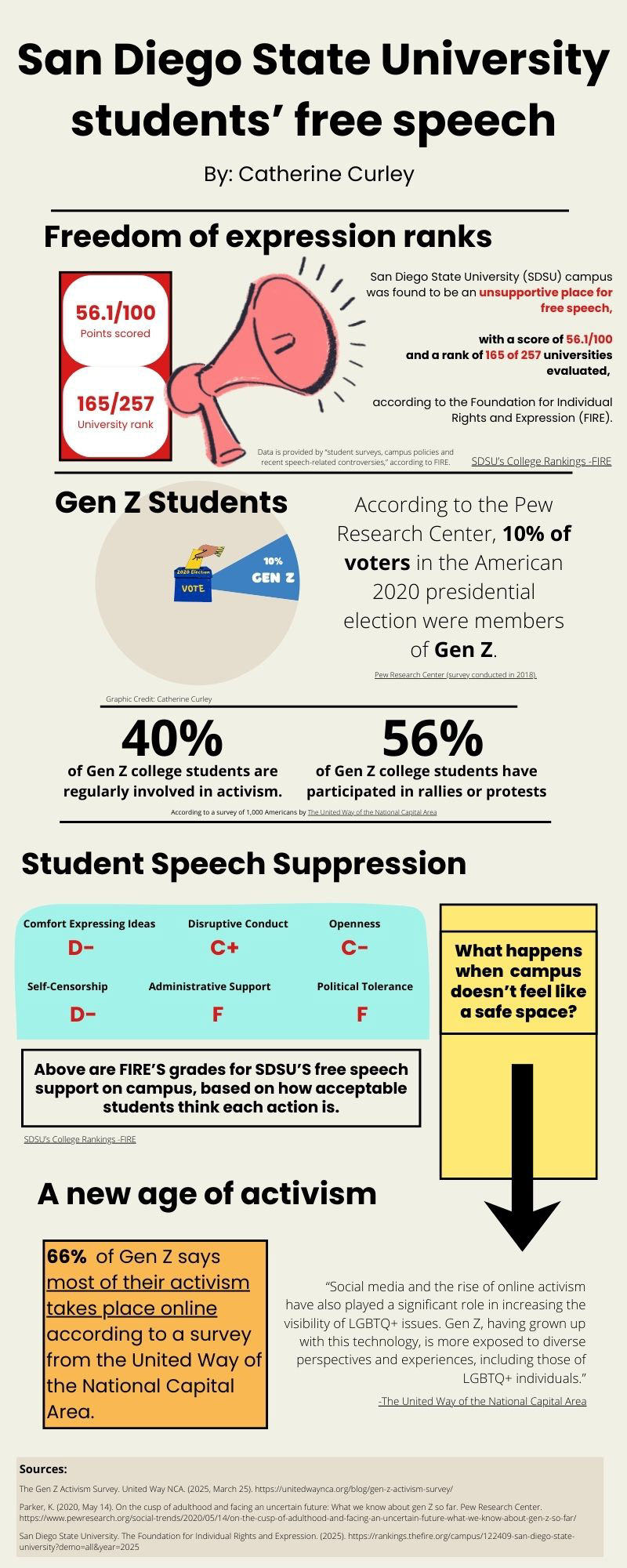
San Diego State Students' free speech infographic by: Catherine Curley
The life of the modern activist
For the past several years, students have not missed an opportunity to speak out against major injustices. Despite this, the Foundation for Individual Rights and Expression (FIRE)’s survey results found San Diego State University to be unsupportive of free speech on campus. SDSU received a score of 56.1/100 for 2025 with near-failing or failing letter grades in each category. SDSU’s ratings have dropped this year due to issues of censorship and student perception, which is a reflection on the institution rather than the students.
Gen Z has shown itself to be more politically savvy than other generations, especially those in higher education. According to a 2023 survey done by United Way of the National Capital Area (United Way NCA) about Gen Z’s involvement in politics and activism, 32% of Gen Z are engaged in activism or social justice regularly. This number becomes nearly 40% amongst those who are college students. In addition, over half of the generation has participated in rallies or protests; again that number increases significantly amongst college students. United Way NCA also found that 66% of Gen Z says that most of their activism is done online.
“I think Gen Z has their own way of protesting,” Zareeb said. “I might not see it (on campus), but it's definitely there. It's on social media. I think that’s where I think the battle really is because that's how people get their news nowadays.”
Activism amongst college students has always been a trend, but the new generation of SDSU students have been able to leverage social media in order to spread a message.
“I worked with (an) immigration law firm… doing a lot of social media campaigns discussing the facts and the data of what's happening to people,” says Zeis-Khalil.
In addition to creating a digital conversation, social media also serves as a way to easily spread information. The SDSU SJP Instagram account has informed campus of its events by posting. Their post for the SDSU for Palestine walk out on April 30, 2024 received 2,532 likes and was shared 1,105 times.
“I guess, maintaining my freedom of speech is in ways like social media – posting about stuff I feel passionately about – talking to my friends, like being able to have discussions – that is a way I’m practicing my freedom of speech,” Hopkins said.
For many students, being able to discuss the issues is half the battle. Both Hopkins and Zeis-Khalil say that SDSU’s administration is uncomfortable addressing controversial topics and purposefully sweeps things under the rug.
Zeis-Khalil alleges that with each notable protest, the constraints on SDSU’s Time, Place and Manner Policy, a set of rules around where and when you can protest on campus, gets tighter.
“They're creating additional policies to narrow what students can and cannot do, so that really speaks for itself,” she says. Updated policies include barring the use of facial coverings during protests as they protect the user’s identity, and limitations on the hours in which students can protest.
“I do believe students do care, just maybe not as outright as other campuses,” says Zeis-Khalil. She urges that the government and the SDSU administration want you to be silent. “Continue advocating, writing to government officials, taking to the streets, to let people know that people are not satisfied,” Zeis-Khalil advises.
Follow @catherinec_journalism for updates and behind the scenes info on stories.